Most SMEs don’t avoid AI because they’re unaware of it.
They avoid it because it sounds like hiring engineers, burning budget, and slowing the business down.
That fear is valid.
But here’s the part most AI consultants won’t tell you:
If you need a tech team to start using AI, you’re doing it wrong.
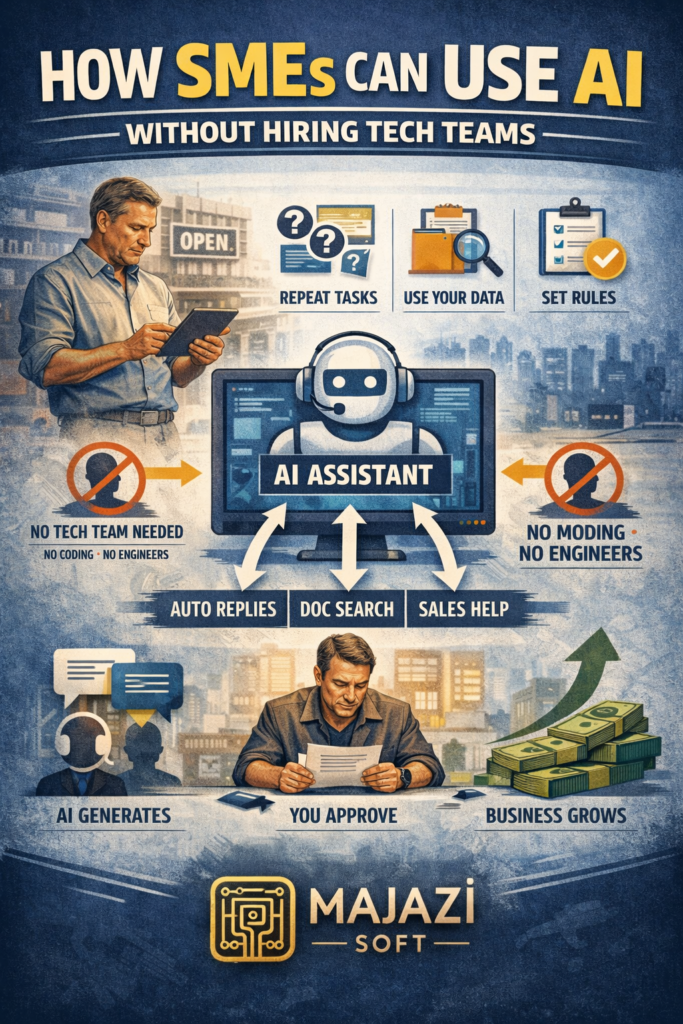
For SMEs, AI is not about building technology.
It’s about removing friction from daily operations.
This article explains how small and medium businesses can use AI today—practically, safely, and profitably—without hiring developers or data scientists.
No hype. No demos-for-Instagram. Just what works.
The Core Mistake SMEs Make With AI
Most SMEs start with tools.
The right starting point is process.
AI only works when it attaches to something that already exists:
- a workflow
- a bottleneck
- a repeated task
- a decision made again and again
If your business is already chaotic, AI will not fix it.
It will amplify the chaos faster.
So before touching any AI tool, answer one question:
“Where do we repeatedly waste time, attention, or money?”
That answer determines whether AI is useful—or a distraction.
You Don’t Need AI Everywhere. You Need It Somewhere Important.
AI delivers value when:
- the task is repetitive
- the output follows patterns
- mistakes are reviewable
- humans stay in the loop
This is why AI-assisted workflows outperform full automation for SMEs.
High-impact examples:
- Drafting emails, proposals, reports → human approves
- Summarizing meetings and documents → team validates
- First-level customer support → staff escalates
- Content drafts → marketing edits
This approach:
- avoids brand damage
- avoids trust issues
- avoids overengineering
Most importantly, it does not require a tech team.
RAG: The One AI Concept SMEs Actually Need to Understand
Forget custom models. Forget training AI.
For SMEs, the most practical AI pattern is RAG (Retrieval-Augmented Generation).
In plain language:
AI answers questions using your business data, not generic internet content.
Instead of “teaching” AI from scratch, you give it:
- your documents
- your manuals
- your product catalogs
- your SOPs
- your policies
AI retrieves relevant information and responds within your business context.
Real SME use cases:
- Internal knowledge assistant for staff
- Customer support bot trained on your products
- Sales assistant that knows pricing, specs, and FAQs
- Operations assistant for policies and procedures
No engineers.
No model training.
No overkill.
This is where SMEs quietly gain leverage while others chase trends.
Stop Tool-Hopping. Build a Simple AI Stack.
Most SMEs sabotage themselves by chasing tools:
“Let’s try this AI… now this one… now another…”
That’s noise.
Instead, think in four layers:
1. Interface
A chat-based AI your team already understands.
2. Business Data
Clean documents, spreadsheets, exports from CRM or ERP.
3. Rules
What AI can answer, what it must refuse, when to escalate.
4. Measurement
Time saved. Errors reduced. Tickets handled. Leads qualified.
If you can’t measure impact, AI is not helping the business—it’s entertaining the team.
You Don’t Need Developers. You Need Ownership.
Here’s an uncomfortable truth:
Most AI projects fail because no one owns them—not because the tech is hard.
SMEs don’t need engineers for most AI use cases.
They need AI operators—people who understand the business and control how AI is used.
This can be:
- the founder
- an operations manager
- a trained internal employee
Modern AI is configured, not coded.
Prompts, rules, and guardrails matter more than programming.
Where SMEs Should Avoid AI (For Now)
AI is not magic. It has limits.
Avoid AI when:
- errors can cause legal or financial harm
- data is sensitive and poorly managed
- you expect AI to “think” instead of assist
- your processes are undocumented
AI multiplies whatever exists.
Bad inputs → confident wrong outputs.
Knowing where not to use AI is a competitive advantage.
How Majazi Soft Approaches AI for SMEs
At Majazi Soft, we don’t push tools or trends.
We work with SMEs in three clear steps:
1. AI Audit
Identify where AI can save time or money inside your existing workflows.
2. Practical Implementation
RAG systems, internal assistants, support automation—built around your data.
3. Enablement, Not Dependency
Your team understands, controls, and owns the AI system.
If AI doesn’t make the business calmer, faster, or more predictable—we don’t recommend it.
Final Thought (No Marketing Talk)
AI is not the future for SMEs.
It’s already operational.
The advantage now belongs to businesses that implement it quietly and correctly.
You don’t need a tech team.
You need discipline, clarity, and the right use case.
If you want help figuring that out, Majazi Soft exists for exactly this stage of adoption.